Why Divorce Makes You Bad at Math
The behavioral economics of why even sophisticated professionals make terrible financial decisions during divorce—and how the billing model makes it worse.
Consider a physician earning $400,000 a year. She manages a department, evaluates complex diagnostic information daily, and makes high-stakes decisions under uncertainty as a matter of professional routine. She is, by any measure, a sophisticated decision-maker.
Now put her through a divorce. Her spouse has filed. Custody is contested. The family home is in dispute. She has retained a well-regarded attorney at $400 per hour. Four months in, she has spent $18,000 in legal fees and the case is nowhere near resolution.
Her attorney recommends deposing three witnesses at an estimated cost of $6,000. The attorney acknowledges the depositions may not change the outcome, but says they could "strengthen the record." She authorizes them without hesitation.
Why?
Not because she lacks financial sophistication. Not because she failed to evaluate the cost-benefit ratio. But because her brain, at this moment, is operating under conditions that behavioral economists have shown to be catastrophic for rational decision-making.
The Cognitive Tax
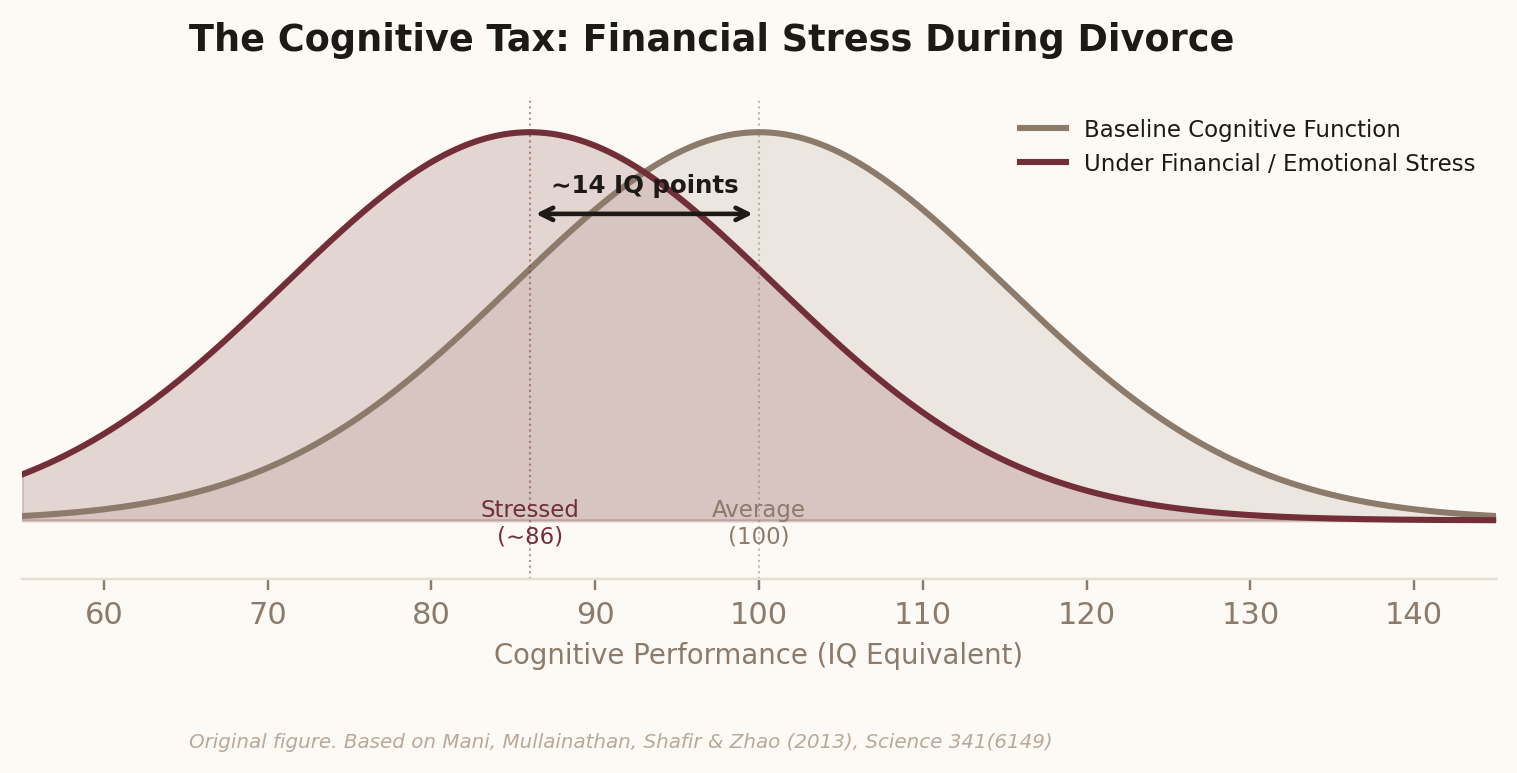
In 2013, researchers Anandi Mani, Sendhil Mullainathan, and colleagues published a paper in Science that should concern every divorce client in America. They demonstrated that financial stress alone—not poverty per se, but the cognitive burden of financial worry—reduces mental performance by the equivalent of 13 to 14 IQ points. That is roughly the difference between "average" and "low-average" on standardized measures.
During divorce, clients experience financial stress, emotional trauma, sleep disruption, and social dislocation simultaneously. The cognitive impairment is not metaphorical. It is measurable, reproducible, and documented in peer-reviewed research.
This is the person being asked to evaluate whether a $6,000 deposition is worth it. This is the person reading a 14-page motion and trying to determine whether the legal arguments are sound. This is the person making the most consequential financial decisions of their life while operating at a significant cognitive deficit.
The Trap Has Five Layers
Cognitive impairment is only the first layer. Behavioral economics has identified at least four additional biases that compound during divorce—each one exploited, intentionally or not, by the hourly billing model.
- Cognitive impairment. Financial and emotional stress strips roughly 13 to 14 IQ points at the moment of decision.
- Loss aversion. Losing the house, the savings, or time with the kids feels about twice as intense as an equivalent gain.
- Sunk cost fallacy. "I've spent $20,000 already—I can't settle for less than that now."
- Information asymmetry. Legal work is a credence good; you cannot tell which motions were actually necessary, even after the fact.
- Anchoring. The initial retainer sets the reference point against which every later invoice quietly gets judged.
Loss aversion is the most powerful. Kahneman and Tversky demonstrated that people experience losses roughly twice as intensely as equivalent gains. In divorce, both spouses perceive themselves as losing—losing the house, losing time with children, losing retirement assets. This triggers risk-seeking behavior: a willingness to spend $50,000 in legal fees to avoid a $30,000 loss in settlement. The math doesn't work, but the psychology is overpowering.
The sunk cost fallacy creates escalating commitment. A client who has spent $20,000 in legal fees feels psychologically unable to settle for an outcome that doesn't "justify" the investment. Experienced mediators report clients insisting that, having spent so much already, the case must be worth more than they have put into it. This reasoning is economically irrational but psychologically predictable.
Information asymmetry means the client cannot evaluate whether the attorney's recommendations are necessary. Economists classify legal services as "credence goods"—services whose quality the consumer cannot assess even after they are delivered. You can tell whether your car runs after a mechanic works on it. You cannot tell whether every motion your divorce attorney filed was necessary.
Anchoring operates through the initial retainer. A $10,000 retainer creates a psychological anchor. When the first invoice arrives at $8,500, it feels reasonable—even when, measured against the value delivered, it may not be. Each subsequent invoice is evaluated relative to the anchor, not relative to the value delivered.
The hourly billing model does not create these biases. But it is optimally designed to exploit every one of them.
The Structural Fix
When the attorney profits from each additional hour, every cognitive weakness becomes a revenue opportunity. The client's loss aversion justifies aggressive litigation. The sunk cost fallacy prevents disengagement. Information asymmetry makes monitoring impossible. And the anchoring effect masks the true cost until it is too late.
A flat fee eliminates the mechanism that connects these biases to billable revenue. When the fee is fixed, the attorney has no financial incentive to exploit the client's compromised judgment. On the contrary, the attorney is incentivized to manage the client's expectations realistically, recommend settlement when appropriate, and resolve the case as efficiently as possible.
You cannot eliminate cognitive biases during the worst period of your life. But you can choose a fee structure that doesn't profit from them.
Related practice area: Family Law
Kynigos Law Firm, PLLC · Washington, DC · Licensed in the District of Columbia. This article is for informational purposes only and does not constitute legal advice. Results may vary depending on your particular facts and legal circumstances.