Your Lawyer Has an Incentive Problem
Economists have spent fifty years studying how hourly billing quietly works against you. Here's what they found.
Imagine hiring a contractor to renovate your kitchen. Now imagine paying that contractor by the hour, with no cap, no estimate, and no penalty for taking twice as long as necessary. Would you expect the project to finish on time?
Of course not. You would expect exactly what the economics predict: the job would take longer, cost more, and involve work that may or may not have been strictly necessary. You would have no way of knowing which hours were productive and which were not, because you are not a contractor and you cannot evaluate the work in real time.
This is precisely the arrangement that most divorce clients enter when they hire an attorney who bills by the hour.
The Principal-Agent Problem
Economists call this a principal-agent problem. The term was formalized by Stephen Ross in 1973 and has since become one of the most studied concepts in microeconomics. The idea is straightforward: when you (the principal) hire someone (the agent) to act on your behalf, and that person has information you don't and incentives that differ from yours, the outcome will be distorted.
In divorce law, the distortion is severe. Your attorney knows which motions are necessary and which are discretionary. You don't. Your attorney knows whether a settlement offer is reasonable. You may not. Your attorney knows how much additional discovery will actually change the outcome. You almost certainly don't.
Under hourly billing, every one of those information gaps becomes a billing opportunity.
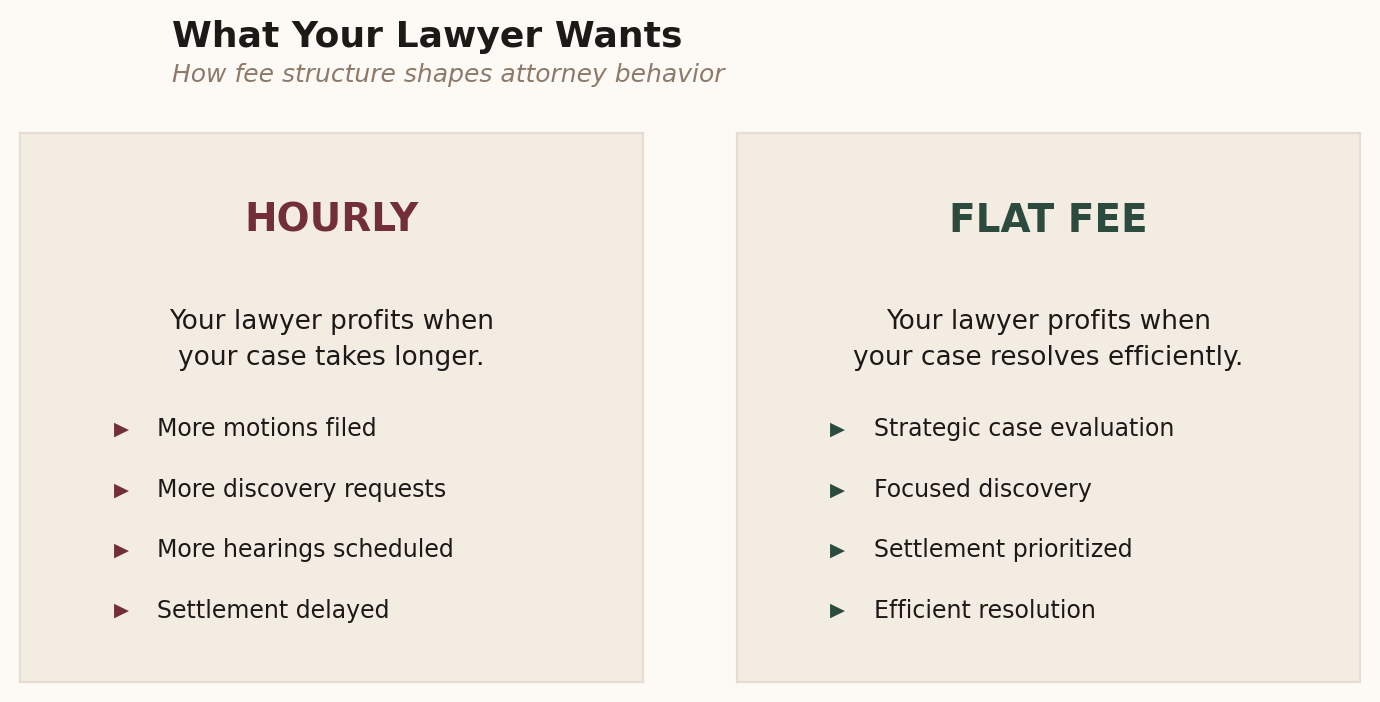
Under hourly billing, your attorney's marginal revenue from working one more hour is always positive. Your marginal benefit from that hour may be zero—or negative.
What the Math Says
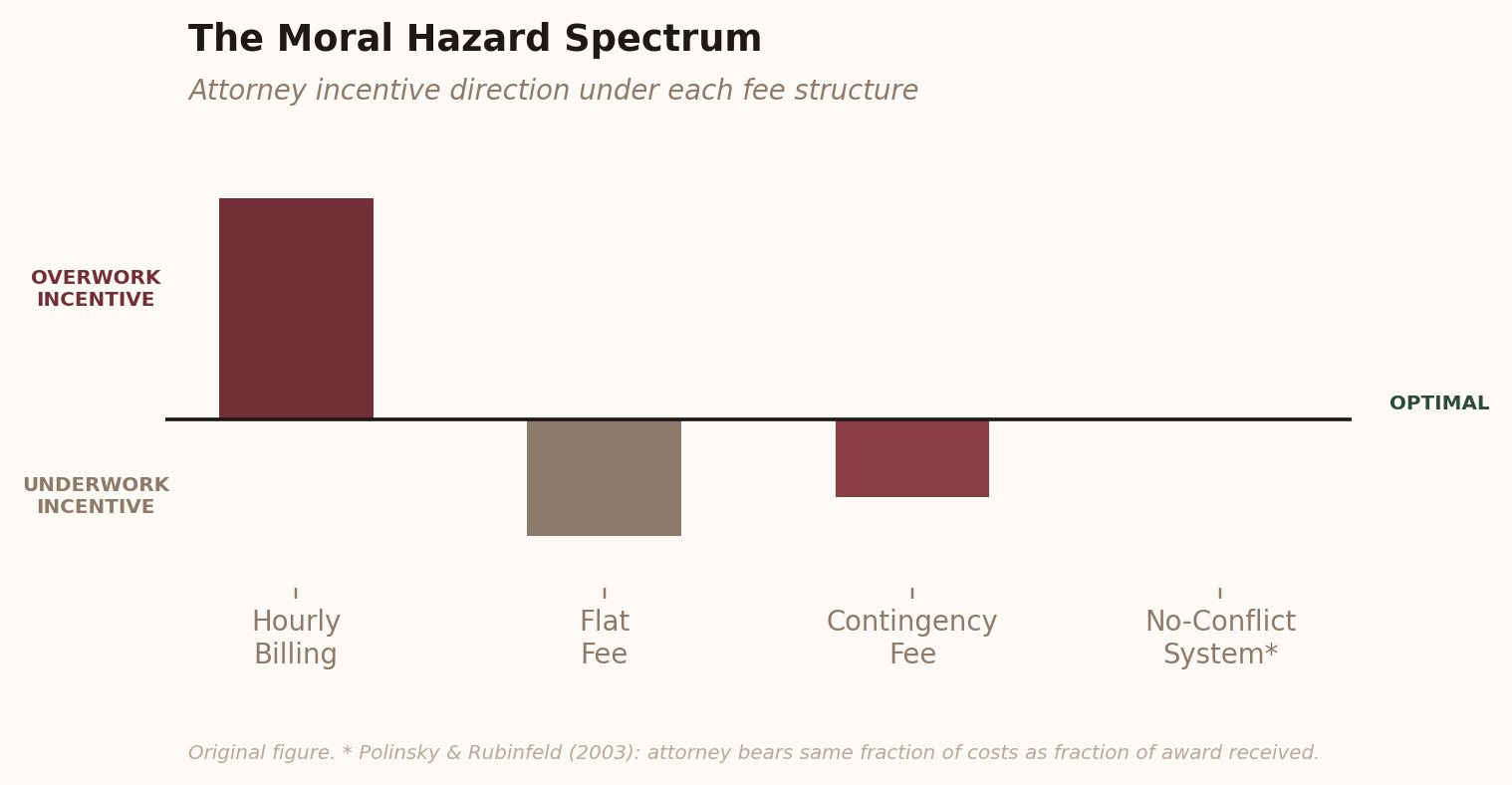
Stanford's A. Mitchell Polinsky and Berkeley's Daniel Rubinfeld published an influential mathematical analysis in 2003. Their model shows that under hourly billing, the attorney's optimal strategy is to work more hours than the client would choose—because the attorney earns revenue from every additional hour, while the client bears all of the cost and may receive no additional benefit.
Under a flat fee, the incentive reverses: the attorney earns the same amount regardless of hours invested, so efficiency is rewarded. A contingency fee ties compensation to the outcome and can create similar alignment—though in domestic-relations matters, where contingency fees are ethically prohibited, the flat fee is the alignment mechanism.
The ABA's own Commission on Billable Hours reached a damning conclusion after two years of investigation: many of the legal profession's most pressing problems converge at the billable hour. Associates at large firms are evaluated on hours billed, not on outcomes achieved. Billing targets of 1,800 to 2,100 hours per year are standard. An associate who resolves cases quickly and efficiently is, in economic terms, punished for doing good work.
The Divorce Escalation Machine
Game theorists have shown that the problem is even worse when both attorneys bill hourly. Geoffrey Miller showed in 1987 that under hourly fees, attorneys on both sides have rational incentives to reject reasonable settlements—because continuing the case generates more revenue for both of them. This is a Nash equilibrium: neither attorney can unilaterally change their behavior without losing income, even though both clients would benefit from earlier resolution.
In a contested divorce, this creates what economists describe as a mutually reinforcing escalation. Your attorney files a motion. The opposing attorney responds. Your attorney files a reply. Each filing is billable. Each response is billable. The case escalates not because the issues demand it, but because the fee structure rewards it.
The Fix Is Not Complicated
The solution is not to find a more ethical attorney. The solution is to change the incentive structure. When your attorney's fee is flat, every unnecessary hour of work is a cost your attorney bears, not you. When the meter is off, the relationship changes from adversarial to collaborative.
Surveys of legal consumers consistently find a strong preference for flat fees, and flat-fee matters tend to resolve more quickly—exactly what the theory predicts.
The economics are not new. The question is whether the legal industry will act on them.
Kynigos Law Firm, PLLC · Washington, DC · Licensed in the District of Columbia. This article is for informational purposes only and does not constitute legal advice. Results may vary depending on your particular facts and legal circumstances.